Andrew Schwartz / 2026-06-15 / 7 min read
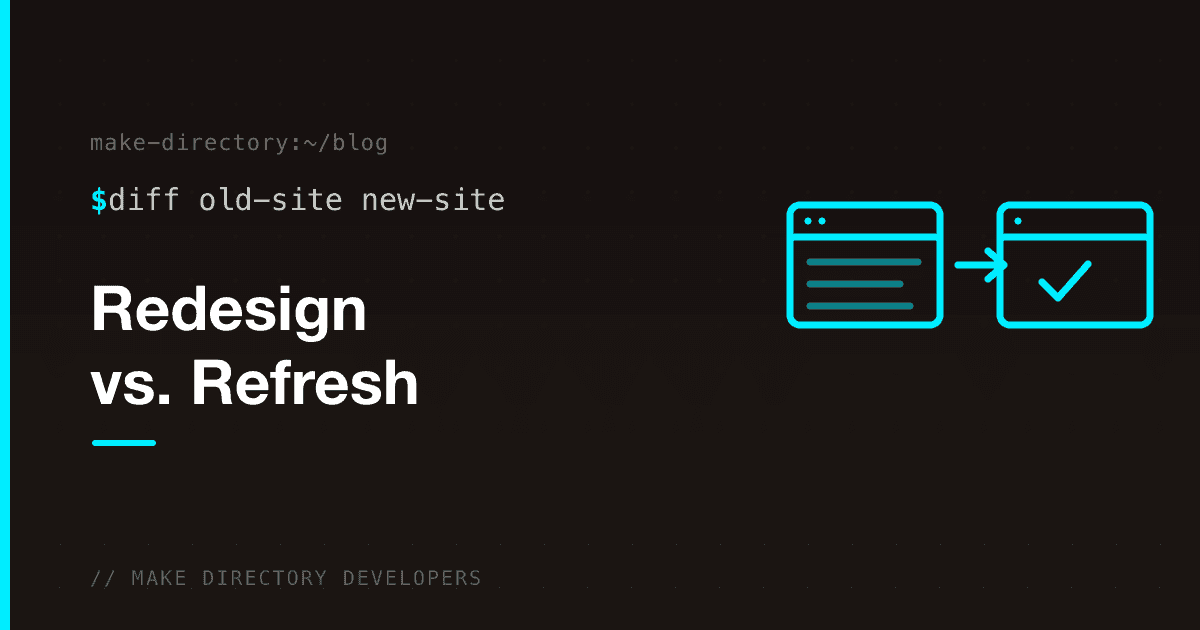
Website Redesign vs. Website Refresh: How to Decide Before You Spend
A practical guide for business owners deciding whether their website needs a full redesign, a focused refresh, or better ongoing support.
Most business owners do not wake up wanting a new website.
They usually arrive there after a few quieter problems start stacking up:
- The site looks a little dated next to competitors.
- The contact form works, but leads are not as consistent as they used to be.
- Editing one page feels harder than it should.
- Search traffic has flattened out.
- The team avoids touching the website because every change feels risky.
At that point, "we need a new website" becomes the default answer. Sometimes that is exactly right. Other times, a focused refresh, a few technical fixes, or better ongoing support can solve the real problem for less money and less disruption.
The difference matters. A full redesign can be a smart investment, but it is also one of the easiest projects to overbuy.
Start With the Problem, Not the Look
Design matters. A modern, credible website can help people trust your business faster. But visual age is only one signal.
Before you commit to a redesign, write down what is actually not working:
- Are the wrong people contacting you?
- Are qualified leads dropping off before they reach the contact page?
- Are important services buried too deeply?
- Is the site slow on mobile?
- Are pages missing the phrases your customers actually search for?
- Is your team unable to publish updates without help?
Those answers point to different types of work. A website that looks old but converts well may need design refinement and content cleanup. A beautiful site that cannot be found in search may need stronger structure, better service pages, and technical SEO. A site that breaks whenever it is updated may need maintenance and development support more than a visual overhaul.
When a Website Refresh Is Enough
A refresh is best when the foundation is still useful, but the experience needs sharpening.
That might include:
- Rewriting key service pages so they are clearer and easier to find
- Improving calls to action on high-traffic pages
- Updating images, spacing, typography, or layout details
- Making mobile pages faster and easier to scan
- Cleaning up metadata, headings, internal links, and page titles
- Fixing forms, tracking, integrations, or other conversion blockers
This is often the right move for businesses that already have a working website, but can feel the site becoming less aligned with how the company sells today.
For example, if your services have changed, your website should not still describe the company you were three years ago. If most of your leads now come through mobile search, your mobile pages should not feel like a squeezed-down desktop layout. If your team has learned which questions prospects ask before buying, those answers should be on the site.
A refresh keeps the useful parts and improves the parts that are holding back growth.
When a Full Website Redesign Makes Sense
A full redesign is usually worth considering when the current site has deeper structural problems.
Common signs include:
- The navigation no longer matches what the business offers
- The site is difficult or expensive to update
- The design system is inconsistent across pages
- The site is built on outdated or fragile technology
- Important user flows are confusing or slow
- SEO performance is limited by poor structure, thin pages, or technical issues
- The services, pricing, or customer journey have changed enough that the current site creates the wrong expectations
In those cases, patching the site can become more expensive than rebuilding it cleanly. You may fix one issue only to discover that the same problem exists across every page template, form, plugin, or integration.
A good redesign is not just a new coat of paint. It should clarify what your business does, make the next step obvious for visitors, protect or improve search visibility, and make future updates easier for your team.
Do Not Throw Away SEO Equity
One of the biggest risks in a redesign is accidentally erasing what already works.
If your website has pages that rank, earn backlinks, or bring in qualified leads, those pages need to be handled carefully. Changing URLs, removing content, rewriting page titles, or launching without redirects can cause avoidable traffic drops.
Before any rebuild, make sure someone is looking at:
- Which pages currently get organic traffic
- Which search terms bring in useful visitors
- Which pages have backlinks
- Which URLs need redirects
- Which content should be preserved, merged, or expanded
- How metadata, headings, and internal links will carry over
SEO is not something to sprinkle on at the end. It should shape the site map, page structure, content plan, and launch checklist from the beginning.
Think About the Website as a Sales System
Your website does not need to be flashy. It needs to help the right people understand whether you can help them.
For service businesses, that usually means answering a few practical questions quickly:
- What do you do?
- Who do you help?
- What problems do you solve?
- What does working with you look like?
- Why should someone trust you?
- What should they do next?
Strong web design supports those answers. It does not bury them behind clever copy or vague visuals.
This is also where website development, web app development, and automation development can overlap. Sometimes the real growth opportunity is not a prettier page. It is connecting your website to a CRM, simplifying intake, automating follow-up, or giving your team a better workflow behind the scenes.
A Simple Decision Framework
If you are unsure which direction to take, use this as a starting point.
Choose a refresh if:
- The site is basically stable
- The core services are still represented accurately
- The main pages can be improved without rebuilding everything
- Your team can already update content reasonably well
- The biggest issues are clarity, conversion, speed, or SEO cleanup
Choose a redesign if:
- The structure no longer fits the business
- Updating the site is painful or risky
- The technology is outdated
- The user experience is confusing from end to end
- A refresh would require touching nearly every part of the site anyway
Choose ongoing support if:
- The site is important to sales, but no one owns it internally
- Small issues keep interrupting campaigns or operations
- You need regular updates, fixes, landing pages, or integrations
- You want the site to keep improving after launch
That last option is often overlooked. A website is not a one-time project for most growing companies. It is part of how the business sells, hires, supports customers, and communicates.
Questions to Ask Before Hiring a Web Partner
Whether you hire Make Directory Developers or someone else, ask a few grounded questions before starting:
- What are we trying to improve: leads, speed, search visibility, trust, usability, or internal workflow?
- Which current pages are valuable and should be protected?
- What will happen to existing URLs?
- Who will write or approve the content?
- How will mobile experience be tested?
- What happens after launch when updates are needed?
- How will we know the project worked?
The answers should be plain. If the process sounds impressive but you still cannot tell what will happen, that is a sign to slow down.
The Better Goal: A Website You Can Keep Using
The best website projects are not driven by panic or vanity. They are driven by a clear business need.
Maybe you need a full rebuild. Maybe you need a sharper homepage, stronger service pages, faster mobile load times, and someone reliable to call when the site needs attention. Either way, the goal is the same: a website that supports the business you are actually running now.
If you are trying to decide between a redesign, a refresh, or ongoing website support, send us a note. We can help you sort out what is worth doing first, what can wait, and where the site is most likely costing you opportunities.

Andrew is the founder and principal engineer at Make Directory Developers. He works where business operations meet software engineering, and spends most of his time inside systems other people built.